
From Promise to Progress: The 2026 IQVIA Digital Innovation Summit Challenged the Industry to Make Innovation Measurable, Meaningful, and Human
Innovation with Purpose: Human Centered Marketing for a Healthier Future was more than the theme of the 2026 IQVIA Digital Innovation Summit- it was the mandate that shaped every discussion, challenged long held assumptions, and reframed what success must look like in today’s healthcare landscape.
Over two days in Brooklyn, more than 400 leaders from healthcare, life sciences, and marketing came together to address an increasingly urgent question: how do we ensure innovation translates into real world access, equity, and impact amid unprecedented complexity?
Across mainstage conversations and focused breakout sessions, the Summit brushed aside abstract possibility in favor of practical reality- spotlighting the challenges leaders face today and the shared responsibility to ensure innovation reaches those who need it most.
A Keynote That Set the Standard for Purposeful Innovation
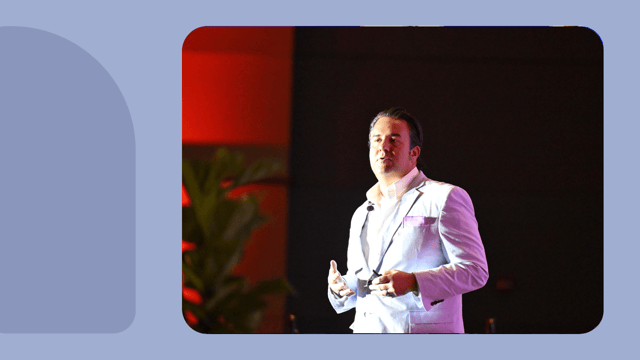
The Summit opened with a powerful keynote from Dr. David Fajgenbaum, whose work as a physician, author, and patient survivor embodies innovation in its most human form. Sharing his personal journey and his groundbreaking work using AI driven drug repurposing to uncover lifesaving treatments, Dr. Fajgenbaum illustrated what becomes possible when data, technology, and human urgency converge.
His story reinforced a central truth that echoed throughout the Summit: innovation is not just about accelerating discovery or deploying new tools—it is about saving lives with responsibility, urgency, and care. Speed and scale matter, but only when they are grounded in trust and directed toward meaningful impact.
“Hope should inspire action—and when it does inspire action in medicine and science, that hope can become reality…. And all of you that work in healthcare—you are the people that can turn that hope into action.”
- Dr. David Fajgenbaum
That principle set the tone for the conversations that followed.
From Promise to Performance: Why AI Still Struggles to Scale
One of the most consistent and candid discussions across the Summit centered on the maturation of artificial intelligence—from experimentation to execution and ultimately accountability. In Architects of Acceleration: Playbooks for AI at Scale in Healthcare, leaders from IQVIA Digital and across industries explored a challenge many organizations are quietly facing: AI pilots are abundant—but scalable success is not.
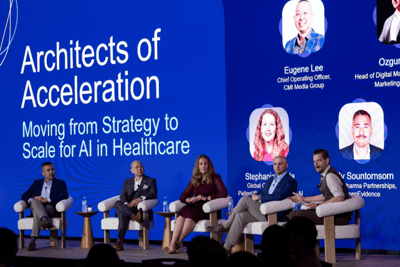
Panelists including Ozgun Demir, Head of Digital Marketing & Lymphoma Marketing at Genentech, Billy Sountornsorn, Vice President of Pharma Partnerships at Open Evidence, Eugene Lee, Chief Operating Officer at CMI Media Group and Stephanie Zinda, Global Offering Lead, Patient/Brand Analytics and AI at IQVIA were candid about the significant upside of these tools, as well as the organizational barriers preventing teams from fully capitalizing on that potential. The barriers, they agreed, are rarely technical. Instead, AI stalls when organizations attempt to layer it onto existing operating models rather than redesigning how decisions, workflows, and accountability function.
True scale requires:
-
Leadership behaviors that create permission to change
-
Governance models that enable momentum without sacrificing trust
Measurement frameworks that reward decision quality and realworld impact—not activity or efficiency alone When AI is embedded into everyday workflows—planning, activation, optimization—it becomes a force multiplier. When it’s treated as a standalone pilot, it risks staying confined to the margins rather
than driving real change.
“Courage and the ability and willingness to experiment—we need to question long-held beliefs and assumptions. And if we don’t question those assumptions, we are not able to innovate and adapt.”
- Billy Sountornsorn, Vice President of Pharma Partnerships at Open Evidence
The takeaway was clear: AI at scale is not a technology challenge—it is an operatingmodel challenge.
When Innovation Outpaces Access, Equity Must Be Designed In
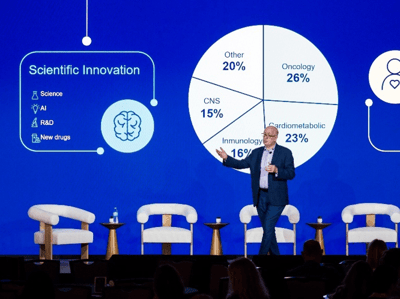
Nowhere were the stakes of purpose more visible than in Healthcare Horizons: Closing Care Gaps in Oncology. As scientific innovation accelerates across oncology, panelists Faith Mutale, DNP, CRNP Nurse Practitioner, Medical Oncology at the University of Pennsylvania, Brian Geist, Chief Strategy Officer at Publicis Health Media, Marianne Gandee Head of Patient Services at Pfizer and Murray Aitken Executive Director of the IQVIA Institute reinforced a critical reality: breakthroughs do not automatically translate into equitable outcomes.
Access gaps persist not because innovation is lacking, but because systems fail to translate science into workflow, evidence into access, and intent into action. Trust, privacy, representation, and affordability must be intentionally designed into pathways—from biomarker testing to treatment initiation—or inequities will persist (or potentially even widen).
Importantly, equity was framed not as an aspiration, but as an operational responsibility- one shaped by how data is used, how stories are told, and how engagement is structured.
“You have done a great job of innovating… you have commercialized a product… you have HCPs prescribing it but at that final mile, a patient is going to confront hurdles based on how their plan is designed…. and there is true disparity depending on your insurance type as to how well you as a patient can get access to care and on innovative therapies.”
- Marianne Gandee- Head of Patient Services, Pfizer
This conversation served as a powerful reminder that progress that doesn’t reach all patients is incomplete.
From Volume to Value: Reframing Precision as an Access Strategy
Another defining shift emerged across multiple sessions, including Precision with Purpose: Redefining Healthcare Marketing for the Modern Patient: the recognition that volume driven engagement is increasingly misaligned with modern care journeys.
Rising costs, hybrid coverage models, regulatory scrutiny, and shifting consumer expectations have fundamentally altered how patients navigate care. In this environment, leaders emphasized that precision can no longer mean better audience design alone—precision must function as an access and experience strategy.
Effective precision engagement:
-
Reduces uncertainty at moments of decision and clarifies next steps amid fragmented pathways
-
Guides patients from intent to initiation—and sustains momentum through persistence
Speakers were candid about the risks of getting this wrong. When personalization manifests as more messages, more content, or more decision points, it doesn’t help—it overwhelms.
Complexity erodes trust. Noise increases leakage. But when precision is designed with restraint, guided by behavioral insights, and adheres to ethical responsibility, it can and will build clarity, confidence, and continuity for patients and care teams alike.
“It is all with such great intent… thinking about the right workflow, the right journeys… but what ends up happening is that you are not set up operationally to pull (personalization) through… and the only person losing out is the patient because they just want to get on therapy.”
- Amanda DeVito, Chief Marketing Officer - Butler/Till
The message was unmistakable: value now comes from helping people move forward, not from reaching them more often.
Reducing Friction Where It Matters Most
Across additional sessions—including Supporting the Strained Care Team and Smarter Launches Under Pressure—leaders returned to a common responsibility: reduce friction where it matters most. Whether supporting clinicians inside real workflows, guiding patients through hybrid access models, or using early adoption signals to inform faster decisions, the imperative was the same.
Modern engagement must:
-
Respect time, context, and cognitive load
-
Prioritize relevance over reach and value over volume
-
Use insight to inform action—not hindsight to explain results
The most effective strategies now align marketing, access, patient services, and analytics around a shared goal: make progress easier, not louder.
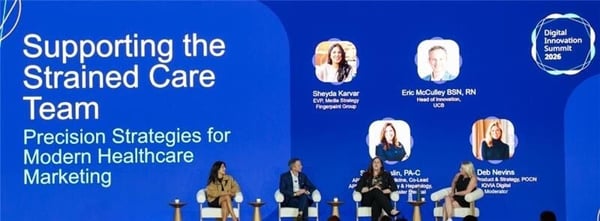
"Are we treating diseases? Yes. But above and beyond that, we are treating people…. And it’s a partnership—how do we get to that ultimate end goal together of treating the needs of the patients?... And the best conversations I have with people (in the industry) are those coming and asking me, “How can I support you and your team?"
- Sarah Enslin, PA-C, MS, APP Manager, Medicine, Co-Lead APP, Gastroenterology and Hepatology , University of Rochester Medical Center
From Reflection to Responsibility: Turning Insight into Action
As the Summit came to a close, one message was unmistakable: the moment for reflection has passed—this is a moment for action. The conversations challenged leaders to look honestly at where innovation is falling short, where complexity is being unintentionally amplified, and where progress is still failing to reach those who need it most.
The call to action moving forward is both simple and demanding. Leaders must return to their organizations willing to ask harder questions:
-
Where is innovation still measured by activity rather than impact?
-
Where have pilots stalled instead of scaled?
-
Where are patients and care teams being asked to navigate complexity the system itself should resolve?
Making innovation measurable requires rethinking how success is defined and how decisions are made.
Making it meaningful requires designing engagement that reduces uncertainty, earns trust, and guides progress—not just generates touchpoints.
And making it human requires ensuring equity, access, and dignity are intentionally built into every pathway, not retrofitted after the fact.
Progress will not come from louder messaging, faster deployment, or more technology alone. It will come from purposeful execution, disciplined design, and leadership willing to align intelligence, experience, and trust around what truly matters.
As we look ahead, the challenge for the industry is clear: move beyond promise, and commit to progress that reaches patients, supports care teams, and stands up in the real world. The organizations that will lead next are those that connect intelligence to action, embed trust and equity by design, and commit to innovation that is humancentered, measurable, and durable.
Thank you to our speakers, panelists, and attendees for making the 2026 IQVIA Digital Innovation Summit such a meaningful exchange. We look forward to continuing the conversation—and to shaping a healthier future together.