

The Hidden Start of the Rural Care Journey: How Precision HCP and Consumer Engagement Helps Close Gaps at the Last Mile of Access
Andrew Burkus, Sr. Director, Thought Leadership, IQVIA Digital
Luke Greenwalt, VP and Lead, U.S. Thought Leadership & Innovation, IQVIA
Jeffrey Duffy, PhD, Sr. Director, U.S. Thought Leadership & Innovation, IQVIA
Kimesha Grant, DNP, MPH, Assoc. Director, U.S. Thought Leadership & Innovation, IQVIA
Sally Little, Assoc. Consultant, U.S. Thought Leadership & Innovation, IQVIA
David Mennen, Data Analyst, Strategic Supplier Services, IQVIA
Key Takeaways
- The last mile of access often begins before the first clinical encounter. Patients frequently signal readiness for care through early digital exploration - researching symptoms, screening, or treatment options long before entering the healthcare system. These moments of health intent are fragile but critical opportunities to prevent delays and disengagement.
- Rural health challenges are local, not monolithic. Disparities across oncology, cardiometabolic, respiratory, and behavioral health are driven less by awareness gaps and more by delayed diagnosis, fragmented care pathways, and breakdowns in continuity - issues that vary by community and that demand precision, not “scale-only” approaches.
- Rural care teams look different, and engagement must reflect that reality. Nurse practitioners, physician associates, pharmacists, and primary care clinicians now serve as the front door to diagnosis, initiation, and disease management. Physician-centric strategies risk missing the providers most responsible for access and outcomes in rural settings.
- Continuity, not awareness alone, is the defining challenge. Sustained progress in rural health depends on reinforcing connections across long, complex care journeys. Aligning healthcare professionals and patients around timely guidance, education, and support is essential to preventing drop-off and translating insight into real-world outcomes.
For tens of millions of Americans, rural health in the United States has reached a pivotal moment as policy changes and new federal investments are unfolding simultaneously. This convergence is increasing risks to access while also creating an unprecedented opportunity to rethink how care is delivered in underserved communities. What is emerging from this moment is that rural health challenges are neither abstract nor uniform. They are often deeply local, constantly evolving, and defined by the realities of who delivers care, and whether patients can stay meaningfully connected to treatment over time.
For organizations seeking to make a meaningful impact, understanding where access gaps exist is necessary, but it is often not enough. The next frontier in healthcare marketing is precision engagement, and the imperative of reaching the right healthcare professionals and patients, with the right support, at the moments that matter most is of critical importance in rural settings. In attempts to engage with patients, it is important to note how often these moments emerge before a clinical encounter occurs. Long before entering a provider's office, individuals begin researching symptoms, exploring screening options, and weighing next steps digitally. These early signals of health intent frequently appear long before patients enter the formal healthcare system, making them some of the most fragile, and most addressable and impactful points in the care journey.
Where the Burden Is Greatest and Why the Stakes Are So High
The urgency of acting at the rural health crossroad becomes even clearer when examining which disease states disproportionately affect rural communities. Across multiple national datasets, rural populations consistently experience higher prevalence, worse outcomes, or slower improvement across several high-impact therapeutic areas—most notably oncology, cardiometabolic disease, chronic respiratory conditions, and mental and behavioral health.
These disparities are not simply matters of incidence. They reflect compounded challenges tied to delayed diagnosis, limited specialty access, fragmented care pathways, and higher rates of treatment discontinuity. Those are the very “last-mile” issues that precision engagement strategies are best positioned to address. For many patients in these communities, these breakdowns begin well upstream, when early signals of concern or readiness for care emerge but often go unsupported. Without timely guidance at these pre-diagnostic moments, delays compound, and the path into care becomes harder to recover.
Redefining HCP Engagement in Rural Care
One of the most consequential, and often underestimated, shifts in rural healthcare delivery is who provides care. Chronic physician shortages mean that nurse practitioners (NPs), physician associates (PAs), pharmacists, and broader care teams increasingly deliver care. National workforce data shows that nearly two-thirds of rural Medicare beneficiaries now receive primary care services from NPs or PAs, underscoring their central role in maintaining access where physician supply is limited. Over the last two decades, the rural NP workforce has quadrupled and the PA workforce has tripled—growth that far outpaces physicians in rural settings.
The proportion of providers in rural areas who are NPs or PAs continues to rise, reaching 38% in 2025. Although they account for only roughly 2 in 5 rural providers, NPs and PAs have an outsized impact, writing approximately half of all prescriptions in rural areas. These trends underscore the central role NPs and PAs play in sustaining rural healthcare delivery. In many communities, they are not simply supplementing physician capacity; they are increasingly serving as the backbone of care. Their expanding presence helps preserve access to primary care, chronic disease management, preventive services, and medication management in areas where physician shortages remain persistent.
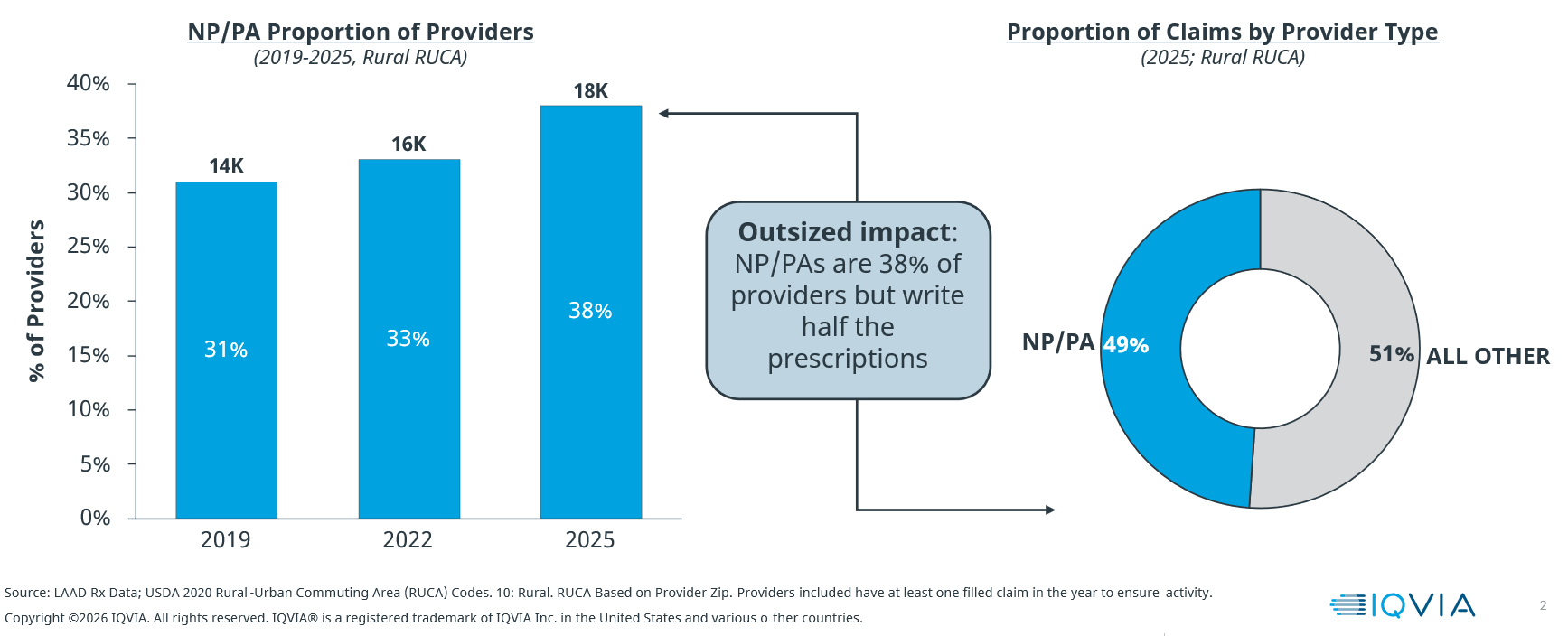
Despite this reality, many engagement strategies remain physician-centric, leaving critical segments of the rural care workforce underserved or misaligned. This disconnect becomes especially problematic in disease areas where rural providers serve as the primary gatekeepers to diagnosis, treatment initiation, and referral.
Oncology: Rising Burden, Delayed Access, Uneven Outcomes
Cancer care illustrates the stakes of rural access challenges more clearly than any other therapeutic area. While overall cancer mortality has declined nationally, those gains have not been shared equally. Over the past several decades, the highest cancer mortality rates in the U.S. have shifted from urban to rural areas, with the gap continuing to widen.
Rural communities over-index for preventable and screen-dependent cancers such as lung, colorectal, cervical, and breast cancer, driven by lower screening rates and reduced access to oncology specialists. Longer travel distances to treatment centers and delays in diagnosis further erode outcomes, making continuity, education, and care navigation critical components of any oncology engagement strategy in rural areas. For many patients, this delay is not the absence of concern, but the absence of support during early exploration when symptoms, family history, or screening questions are first researched. In rural areas, those digital moments of health intent may be the only opportunity to guide patients toward timely evaluation before care gaps widen.
For brands operating in oncology, success in rural markets increasingly depends on reaching non-oncologist providers, including primary care clinicians, NPs, and PAs, who often serve as the front door to diagnosis and referral while also supporting patients through longer, more complex care journeys. In this context, precision engagement is not just about reach; it is about relevance.
Cardiometabolic and Chronic Disease: High Prevalence, Fragile Continuity
Rural populations also shoulder a disproportionate burden of cardiovascular disease, diabetes, obesity, and chronic lower respiratory disease. Adults in rural areas are more likely than their urban peers to have high blood pressure, diabetes, obesity and to die prematurely from heart disease and stroke. Diabetes prevalence alone is 9% to 17% higher in rural areas compared to urban settings, with especially high rates across parts of the South and Midwest. These conditions require sustained management, regular monitoring, and long-term adherence—yet rural patients face greater barriers to consistent follow-up, specialty care, and lifestyle support.
Enabling the ability to access, interpret and act upon early health intent is key in cardiometabolic disease. Research signals around lifestyle change, symptoms, or medication options, present opportunities to engage and inform well before formal treatment begins. Recognizing and supporting those moments can help reinforce timely initiation to new innovations in rural areas.
When examining GLP-1-related Audience Identity Manager® XR (AIM XR) research interactions by county, rurality alone does not appear to be a strong divider of research activity. In an analysis of 1.4 million unique providers in 2,000 counties, average AIM XR interactions per provider remain relatively consistent across county percent rural segments, ranging from 32.0 interactions per provider in the least rural counties to 34.7 in the most rural counties. The provider-level distribution similarly shows substantial overlap across rurality levels, with providers in both less rural and highly rural counties engaging in comparable levels of research activity. The implication is that the opportunity is less about where providers are located and more about when and how they are engaging.
Identifying early research moments across geographies can help capture signals of interest before they are visible through more traditional segmentation approaches. Engagement strategies should build on these signals by supporting both patients and providers as they seek information. This approach can help accelerate appropriate awareness, confidence, and adoption of new innovations across both rural and non-rural geographies.
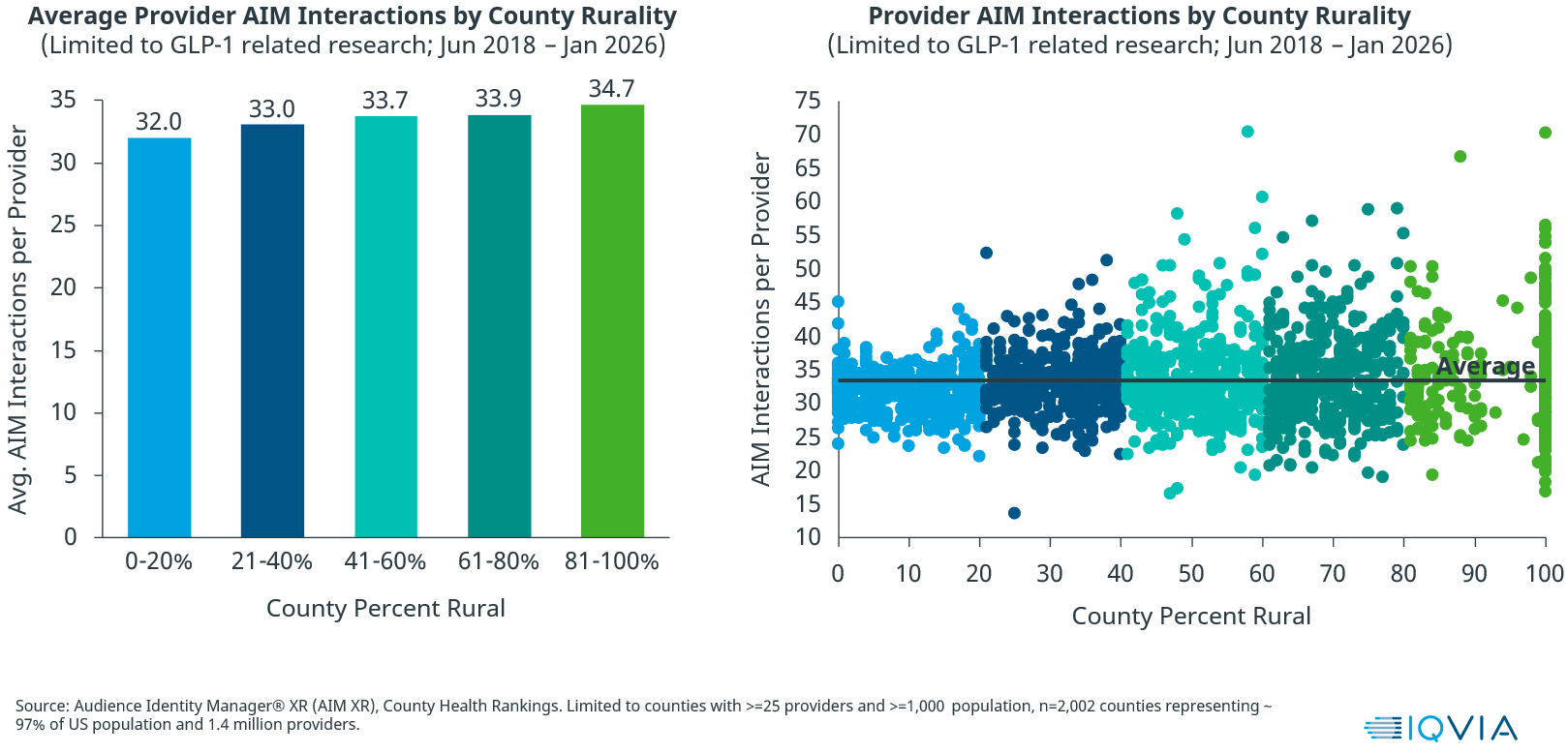
Additionally, continuity-focused engagement becomes essential. For cardiometabolic brands, supporting initiation is not enough; sustained outcomes depend on reinforcing adherence, education, and motivation over time—often through primary care-led teams rather than specialists. Engagement strategies that fail to reflect this reality risk breaking down long before clinical benefit is realized.
Why Disease Burden Reinforces the Case for Precision Engagement
Across these therapeutic areas and many others, the pattern is consistent: rural health challenges are magnified where care pathways are long, fragmented, and dependent on non-specialist providers. As a result, traditional, awareness-driven engagement models often fall short with the burdens of inaction leading to inequities both of access and ultimately outcomes. Precision engagement—across both healthcare professionals and consumers—offers a meaningful path forward:
- For HCPs, it ensures education and support reach the clinicians most responsible for diagnosis, initiation, and longitudinal management—not just specialists.
- For patients, it prioritizes continuity, recognizing that the last mile of access often begins long before treatment, when individuals first signal readiness or concern.
- Engagement that responds to these early moments can help bridge gaps created by distance, workforce shortages, and fragmented rural systems.
At the crossroads of rural health, the choice ahead is not simply about funding, policy, or innovation- it is about execution. Disease‑state realities make clear that access breaks down not in a single moment, but across a series of missed or unsupported transitions: before diagnosis, between providers, and over the course of prolonged treatment.
The path forward demands a more precise approach—one that recognizes who delivers care in rural communities, acknowledges how patients enter and move through the system, and responds to the earliest signals of health intent and need with relevance. Progress will not come from knowing where gaps exist alone. It will come from translating insight into the engagement that drives sustained improvements in population health across underserved communities.
.png?width=640&height=360&name=oct%201%20FACT%20SHEET%20TEMPLATE%20(1).png)