
The Signal Economy and the Race to Know What Matters Next
Please Note: This article serves as a companion piece to the Fierce Pharma Week keynote, "The Signal Economy and the Race to Know What Matters Next," presented on September 15, 2026. It explores a central question facing modern healthcare organizations: if access to information is no longer scarce, what will define competitive advantage in the years ahead?
Information Is No Longer Scarce.
Interpretation Is. For much of modern business history, competitive advantage depended on access to scarce assets: scale, distribution, market reach, and information that others could not easily obtain. The assumption was straightforward: more information would lead to better decisions.
Few healthcare organizations suffer from a lack of information. Research behavior, treatment decisions, prescribing trends, patient journeys, media exposure, and digital interactions contribute to an expanding universe of data. AI is increasing both its volume and the speed at which it can be analyzed.
Yet abundance has created a paradox: organizations possess more information than ever while becoming less certain they are seeing the complete picture. As channels, platforms, and data environments proliferate, the challenge is no longer capturing information. The challenge is creating understanding across increasingly fragmented systems.
The challenge has shifted from gathering information to interpreting it, and AI illustrates that transition perfectly.
Early predictions suggested that it might replace traditional healthcare research behaviors. Emerging evidence points to a more nuanced reality. Four in five physicians report using AI professionally, while healthcare professionals continue to generate more than 68 million deep research events1 each month across trusted healthcare information environments.
Evidence still matters. How it is discovered is evolving.
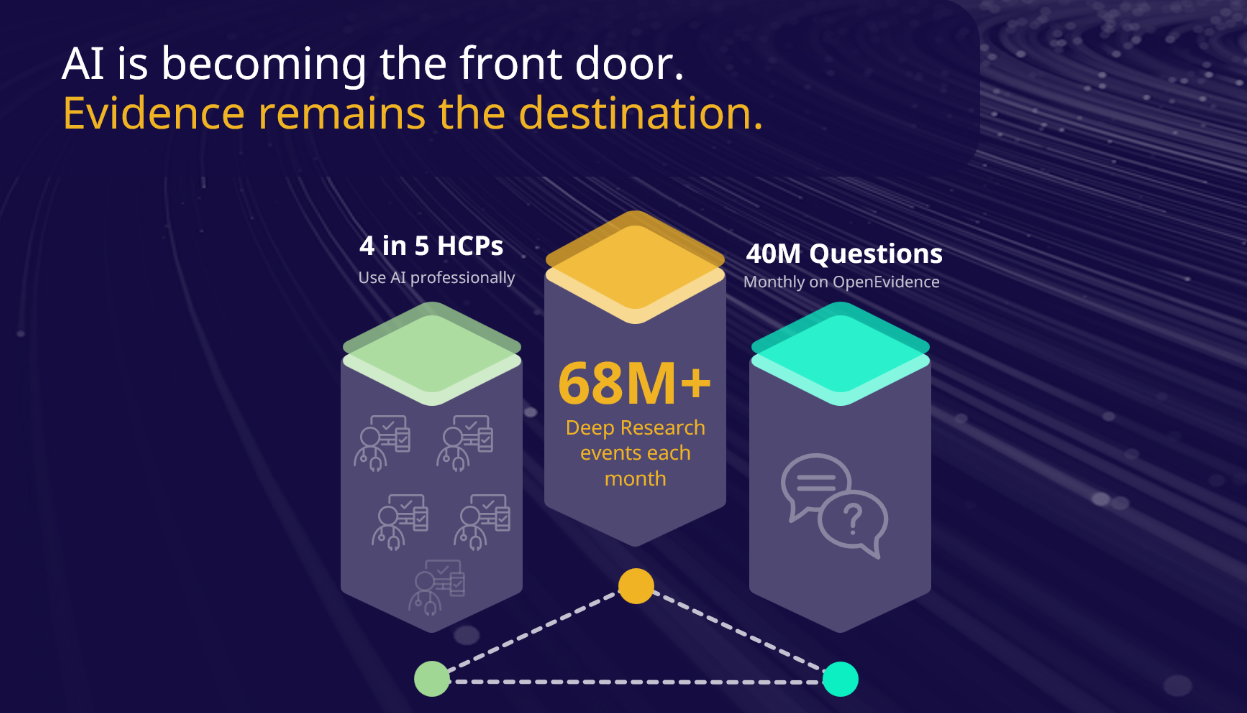 AI is changing how healthcare professionals discover information, but not whether they seek evidence. Research behavior continues to grow alongside AI adoption. Source(s): IQVIA Digital. Audience Identity Manager® XR (AIM XR) Analysis; OpenEvidence. Platform utilization data provided through direct correspondence indicating approximately 40 million questions submitted monthly, Aug. 2026.
AI is changing how healthcare professionals discover information, but not whether they seek evidence. Research behavior continues to grow alongside AI adoption. Source(s): Healthcare professionals increasingly move among AI-generated answers, endemic content, journals, brand resources, and clinical evidence. AI may increasingly become the front door, but evidence remains the destination.
Each step in that evolving journey creates an observable signal. Organizations capable of recognizing meaningful change within those signals can act before traditional outcome measures reveal what is happening.
That is the foundation of the Signal Economy.
The Signal Beneath the Signal
A signal is more than a datapoint. It is an indication that something meaningful may be changing before traditional performance measures fully reveal it.
Healthcare organizations have long searched for these signals. Commercial teams, for example, have relied on leading indicators such as Audience Quality because of their relationship with downstream business outcomes. That confidence is understandable.
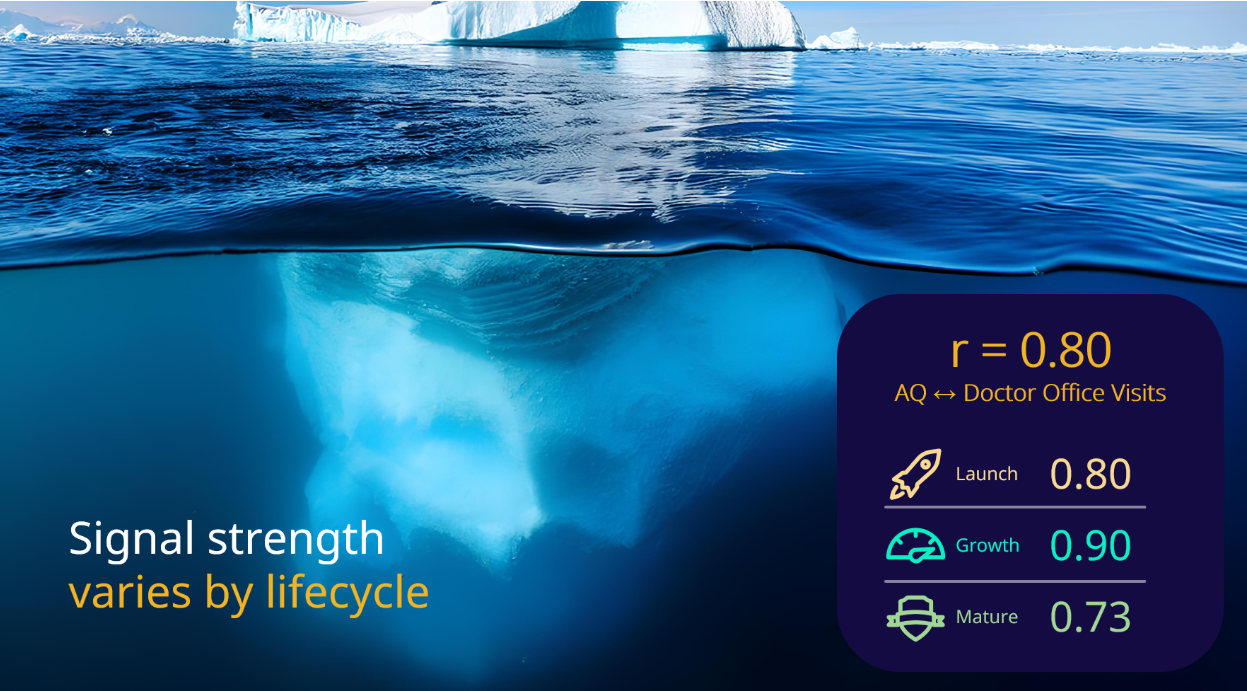
Recent analysis revealed a compelling relationship between Audience Quality and doctor office visits2. A topline correlation of 0.80 would give most organizations confidence that they had identified something meaningful.
 Audience Quality maintained a positive relationship with doctor office visits across brand lifecycles, but signal strength varied. The signal remained real. Its predictive power was contextual. Source(s): IQVIA Digital. Audience Quality Analysis: Jan.-Dec. 2025.
And many would stop there. The metric works. The analysis is complete. Everyone moves on.
But in the Signal Economy, a strong relationship begins the analysis. It does not end it. Averages rarely create competitive advantage.
Examining the same relationship by brand lifecycle revealed a more consequential story. The signal remained real. Its predictive power became contextual.
 Many of healthcare's earliest signals emerge long before diagnosis, treatment, or claims data ever appear- and are often not solely accessed by the professional communities for which they were intended. Source(s): IQVIA Digital. Audience Identity Manager® XR (AIM XR): Digital Research Events Analysis, Mar.-Aug. 20253.
That distinction represents an important shift in how organizations evaluate leading indicators and use them to guide measurement and optimization.
Historically, many analyses have focused on determining whether a signal works.
Increasingly, the better question is not simply whether a signal works, but when, where, and for whom it matters most. A topline metric reveals that a relationship exists. Deeper analysis reveals where opportunity lives.
The same principle extends to patients, who may research symptoms, explore treatment options, and compare therapies well before entering the formal care system. These moments of digital exploration are often among the earliest observable signals in healthcare.
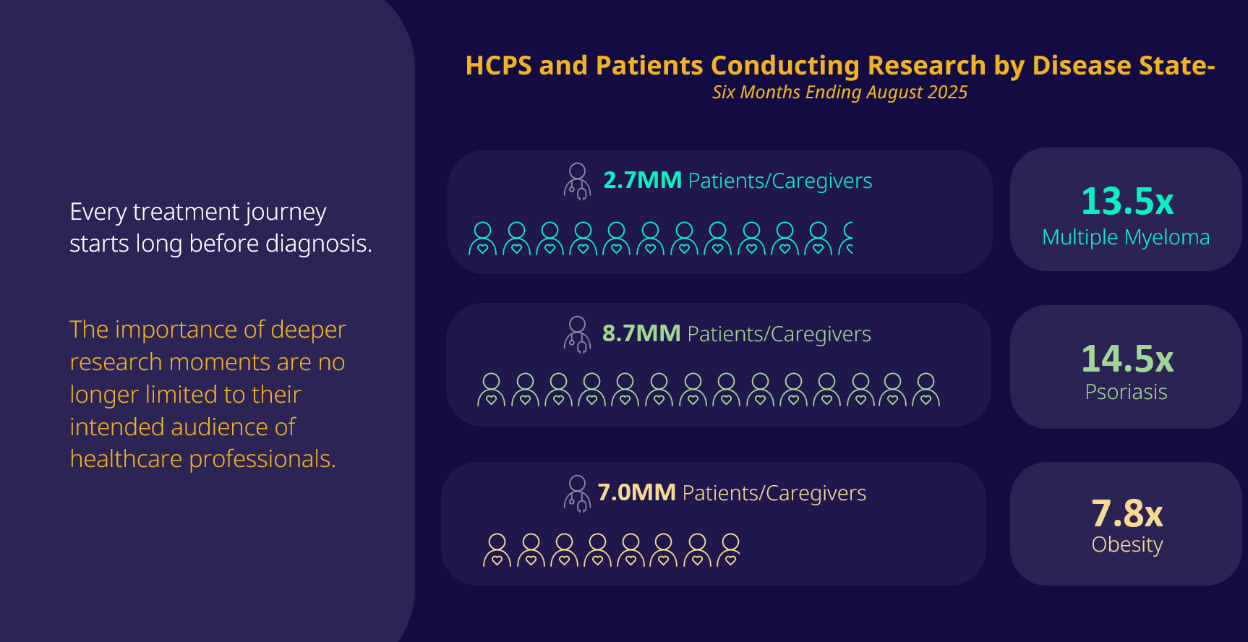 Many of healthcare's earliest signals emerge long before diagnosis, treatment, or claims data ever appear- and are often not solely accessed by the professional communities for which they were intended. Source(s): IQVIA Digital. Audience Identity Manager® XR (AIM XR): Digital Research Events Analysis, Mar.-Aug. 20253.
By the time a diagnosis appears in a dataset or a prescription is written, those signals may have been visible for far longer. Yet the value of these signals extends beyond their ability to appear earlier.
For years, healthcare organizations have treated deep research behaviors primarily as indicators of interest or demand. But what does it mean when patients en masse begin researching symptoms, exploring treatment options, or seeking clinical information in environments historically designed for healthcare professionals?
Increasingly, the story appears more complicated. These signals may not simply reflect demand. They may reveal friction.
What appears to be interest or intent may actually be hidden signals from patients trying to navigate a healthcare system that has become increasingly difficult to traverse. Broader research points to a growing accumulation of access barriers, affordability pressures, fragmented care pathways, and adherence challenges that can delay progress long before those consequences become visible in traditional measures4.
These signals may indicate a patient struggling to access care, searching for answers before or after a diagnosis, navigating reimbursement challenges, or attempting to remain engaged in a treatment journey that is becoming increasingly difficult to sustain.
In other words, a signal may not mean what we initially assume it means or what it might help predict.
What appears on the surface to be demand may represent unmet need. That distinction matters.
Organizations that misinterpret signals risk optimizing for the wrong problem. Those that understand the context surrounding a signal are better positioned to intervene earlier, address barriers, and improve outcomes before the consequences become visible through traditional measures.
Information tells us that a signal exists. Intelligence reveals its significance.
Organizations now have access to engagement metrics, intent scores, behavioral models, prescribing data, patient-journey information, and AI-generated recommendations. Across them all, the limiting factor is no longer observation. It is interpretation.
Competitive advantage increasingly depends not simply on knowing who customers are, but on recognizing when and how their behavior begins to change.
Context Creates Intelligence
Even a strong signal can mislead when context is incomplete. The danger is rarely that organizations see nothing. More often, they see enough to become confident. The problem is that confidence can emerge long before context, creating a situation where disconnected observations begin masquerading as intelligence.
Signals do not exist in isolation. A provider researching a therapy category may create an interesting signal, but understanding who that provider is, which patients they treat, and where they sit within an adoption curve gives that signal meaning.
The challenge intensifies as healthcare activity spreads across channels, devices, platforms, publishers, care settings, and data providers. Fragmentation is increasingly becoming the operating system of the market. Advantage comes not from eliminating it, but from creating clarity within it.
Organizations may observe numerous interactions and behaviors yet remain uncertain whether those observations actually belong to the same individual, the same journey, or even the same story.
Customer-level signals become actionable intelligence when they can be resolved to the same person and understood within the same journey.
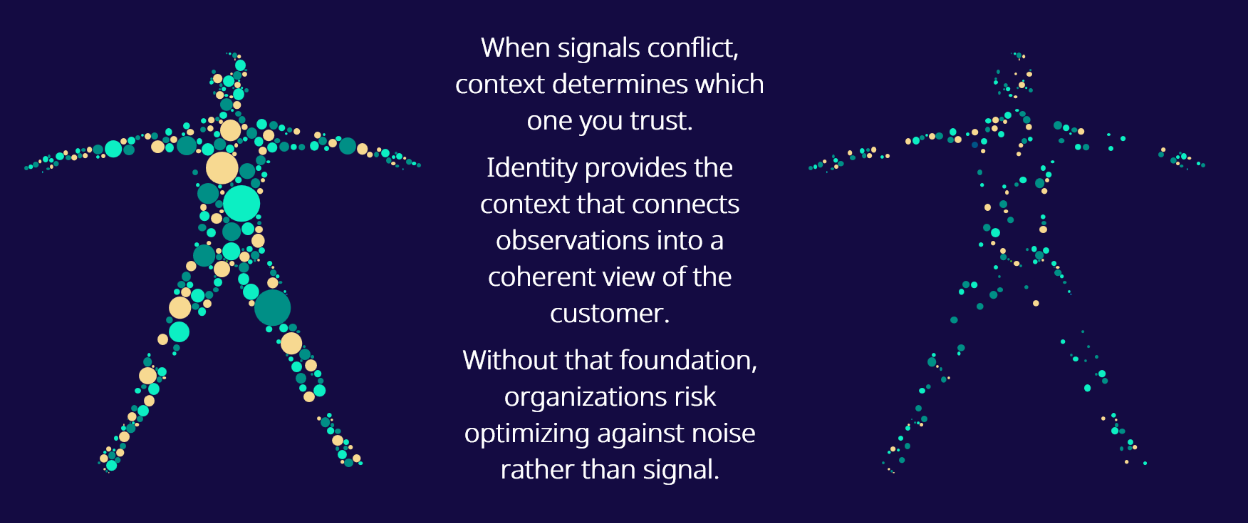 Identity provides the continuity required to determine whether fragmented observations reflect the same customer, the same journey, and the same underlying story.
AI Does Not Solve Weak Signals. It Amplifies Them.
The growing adoption of AI makes this challenge even more important.
Healthcare organizations are exploring how AI can increase efficiency, accelerate analysis, improve targeting, automate workflows, and generate insights.
These investments are valuable, but they are unlikely to create sustainable competitive advantage on their own. As AI becomes increasingly democratized, advantage shifts away from the technology itself and toward the quality of the information guiding it.
AI can identify patterns, accelerate analysis, and surface relationships that might otherwise remain hidden. But it cannot independently determine whether a signal is meaningful, compensate for unresolved identity gaps, or establish whether fragmented observations belong to the same journey.
It scales understanding. It also scales misunderstanding. When weak or disconnected signals guide AI systems, organizations may make increasingly confident decisions while moving further from reality.
The challenge is not only technological. It is foundational. Before organizations can fully benefit from AI, they must first establish confidence in the signals feeding it.
A New Definition of Competitive Advantage
Every era creates its own source of advantage.
In the industrial era, advantage came from scale. In the digital era, advantage came from attention.
In the Signal Economy, advantage increasingly comes from recognizing meaningful change before it becomes obvious.
This requires a different set of capabilities:
-
Detect meaningful signals and understand the context in which those signals matter most.
-
Connect fragmented observations through identity.
-
Transform signals into intelligence.
-
And ultimately act while opportunity still exists.
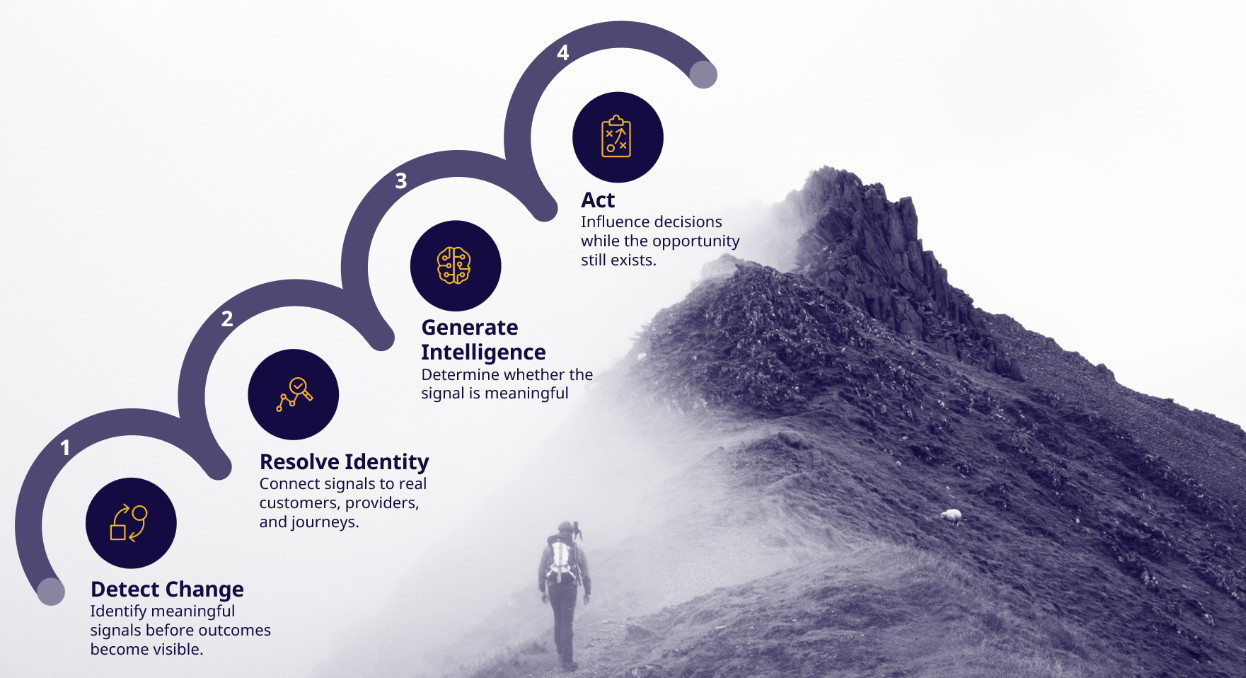 Signal advantage requires four connected capabilities: detecting meaningful change, resolving identity, generating intelligence, and acting while opportunity still exists.
These four capabilities require measurement that does more than document past performance. Within a signal-driven organization, measurement helps detect change, connect observations through identity, determine whether emerging signals are meaningful, and translate intelligence into action. The future of measurement is not retrospective validation. It is decision intelligence.
Organizations will not differentiate themselves simply by collecting more data or deploying more AI. They will differentiate themselves by connecting signals, establishing context, and embedding intelligence into decisions before the opportunity passes.
Information is abundant. AI is becoming ubiquitous.
Signal remains scarce.
In the Signal Economy, competitive advantage belongs to organizations capable of recognizing what matters next and acting before everyone else sees it.
-
IQVIA Digital. Audience Identity Manager® XR (AIM XR) Analysis. Proprietary analysis of behavioral data through Aug. 2026 identifying 408 million deep research moments among HCPs. Unpublished internal research.
-
IQVIA Digital. Audience Quality Analysis: Jan.-Dec. 2025. Proprietary analysis of 242 billion impressions spanning 14 campaigns and 8 disease states. Unpublished internal research.
-
IQVIA Digital. Audience Identity Manager® XR (AIM XR): Digital Research Events Analysis, Mar.-Aug. 2025. Proprietary analysis comparing digital research activity among consumers and healthcare professionals across select disease states. Unpublished internal research.
-
Greenwalt, Luke, and Anika LaFazia. "Patient Behavior: How Does Price Sensitivity and Adherence Shape the GLP-1 Market." IQVIA, Nov. 2025.